
Has your restaurant been attacked by web spoofing or cyber squating?
Would you know?

Every day thousands of businesses experience some type of web threat.
According to FTC data, the FBI received 859,000 web spoofing and business identy theft complaints in 2024, with damages topping $16 billion.And most of the time, the business owners had no idea anything was happening.
Web spoofing is a form of business identity theft where the attacker uses data scrapers to gather website data. They then create fake websites with the information, which may look perfectly legitimate.Yet, the fake sites are used to collect customer information, transaction data, or any other type of marketable details.Often the fake website ranks higher in search engines than the restaurant's real website or Facebook pages, which can lead to lost traffic, customer confusion, and ultimately a soiled reputation.In the most serious cases, credit card and payment information is stollen, and in others, cyber crinimals attemp to extort payments from business owners to end the practice.
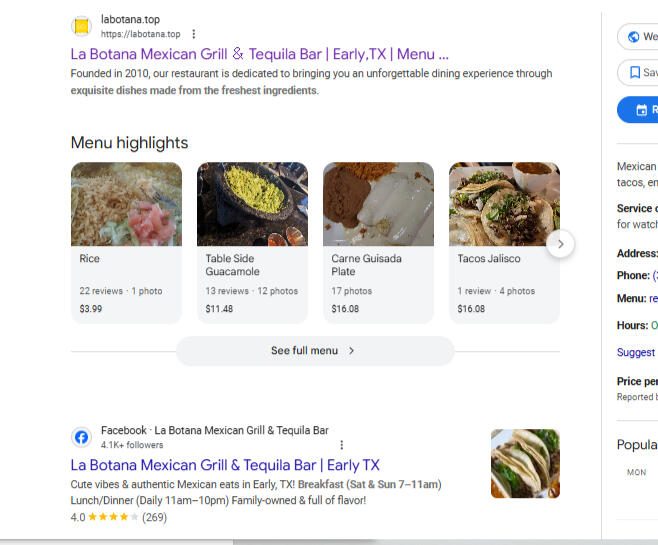
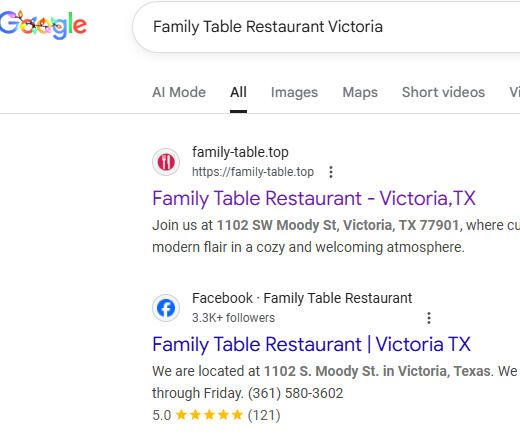
Web spoofing examples
This example demonstrates how the fake website can rank higher on a Google search than the restaurant's Facebook page.This can be confusing to potential customers and potentially dangerous for the site visitor.
Same case in this example. When customers search for this restaurant, most will click through to the top result, leading to the fake site.In both of these cases, the restaurant owners were unaware of the existence of these fake websites.
Potential damage to the business
The victim of these cyber crimes can be harmed in three gerneral areas, reputational damage, financial damage, and customer harm.
Confused and frustrated customers leave reviews on Yelp such as “I ordered online and nobody answered!” or “Website is broken, terrible service.” These harm the restaurant's reputation.
Such reputational damage can impact sales and profits. Further, the high search ranking of the fake sites can lead to lost web traffic and shrinking orders.
Unlimately, the most serious harm may be felt by the restaurant's customers. By clicking on the fake sites and ordering, their sales will be unfufilled, and their private information could be collected and sold.
Web spoofing and cyber squatting are federal crimes under the Anticybersquatting Consumer Protection Act (ACPA, 15 U.S.C. § 1125(d)), which targets intent to deceive, divert traffic, or extort.And yet, the FTC explicitly notes that the vast majority of frauds go unreported, meaning businesses often don't realize they're victims until after losses mount (e.g., via chargebacks, bad reviews, or stolen data).
Who we are
BFM Cyber Security was founded to fight web spoofing and cyber squatting. Our clientele is primarily independent restaurants, with a smattering of other small businesses.Our engagements involve shutting down the fake sites, reporting the acts to theproper athorites, and monitoring the clients' operations to avoid future threats.
Would you like to work with us?
We work with independent restaurants and small businesses throughout the country, fighting cyber crime and repairing the damage. If you feel your business is experiencing potential cyber crimes, please reach out.
© Untitled. All rights reserved.